


New safer concentrated potassium measure launches on OpenPrescribing Hospitals
- Posted:
- Written by:
-
- Vicky Speed, Chris Wood, Bryony Dean Franklin, Louis Fisher
- Categories:
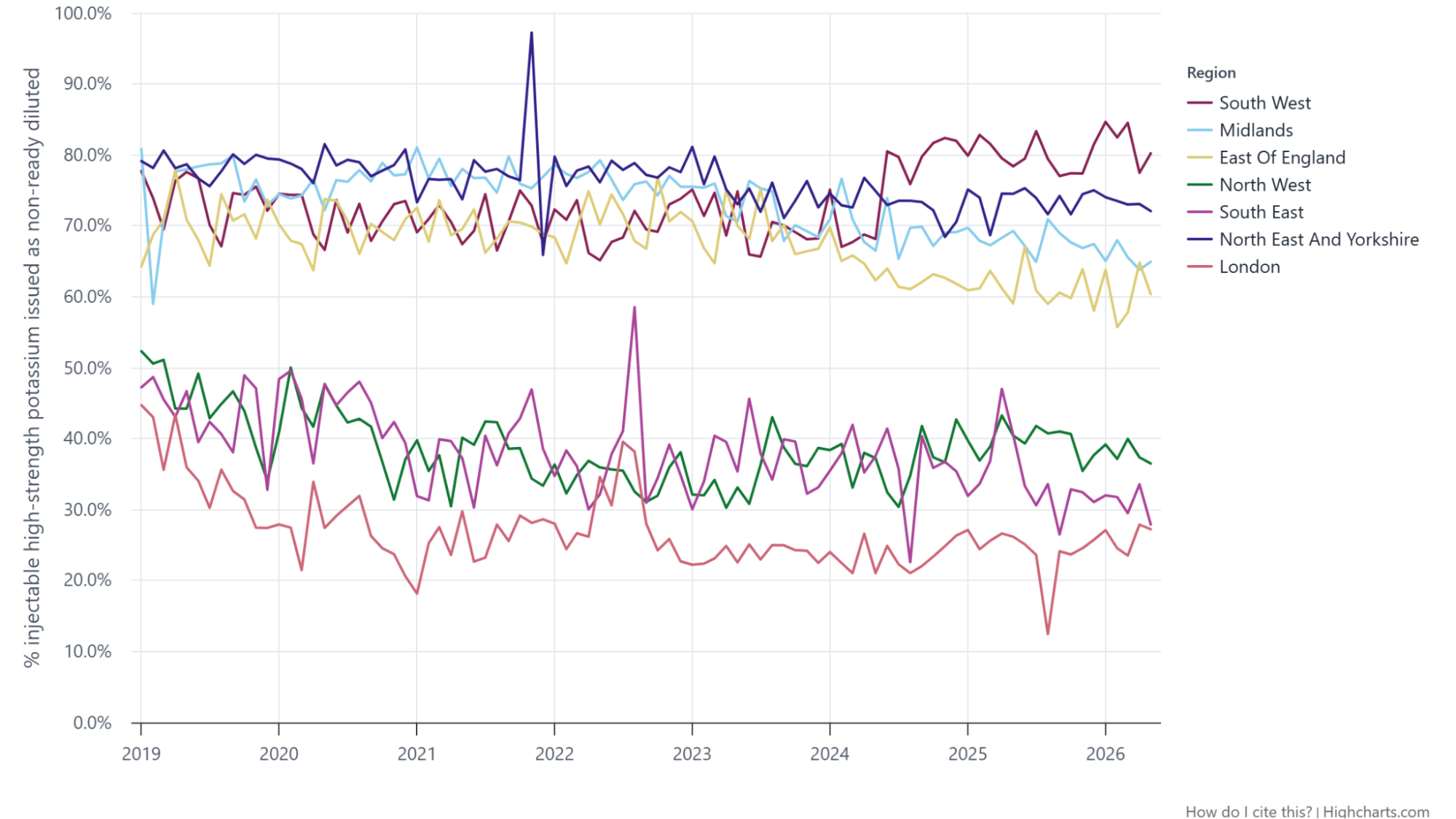
We’ve launched a new measure to monitor the percentage of concentrated (>80 mmol/L) potassium chloride or potassium dihydrogen phosphate (potassium acid phosphate) issued as non-ready diluted products. The new measure is already live on the site - have a look now! You can view this measure by all trusts, NHS region or nationally.
Why build this measure?
In the very early days of OpenPrescribing Hospitals, we were looking for measures that we could build using published NHS standards. A chat with a Medicines Safety Officer (MSO) led us to look at the NHS England Enduring Standards, and to see whether we could build measures for these.
The NHS England enduring standards are specific actions from previous patient safety alerts identified as likely to always be relevant or unlikely to change in the immediate future. They represent actions that should be embedded systematically across NHS provider organisations.
We decided to first focus on building a measure for concentrated potassium and the risk of mis-selection of a strong potassium solution.
What is the safety concern?
Concentrated potassium solutions are high risk medicines which, if administered incorrectly, can cause potentially fatal arrhythmias and cardiac arrest.
A patient safety alert - Potassium solutions: risks to patients from errors occurring during intravenous administration was first published in 2002 with the aim of reducing the risk of accidental overdose of intravenous potassium arising from the use of potassium chloride concentrate solutions and other strong potassium solutions. More recent Specialist Pharmacy Service guidance reiterates this risk. Both recommend the use of commercially available ready-to-use diluted potassium solutions wherever possible to reduce the risk of fatalities from potassium overdose.
How is the measure defined?
This measure focuses on injectable products containing potassium chloride or potassium dihydrogen phosphate with a strength greater than 80 mmol/L. The threshold of >80 mmol/L is based on the previous Royal Pharmaceutical Society benchmarking metric for the safer use of intravenous potassium salts.
For the purposes of this measure, we define non-ready diluted products as those supplied in a total volume of 20 ml or less. We include both licensed and unlicensed products in the measure, as the focus is on the use of ready-diluted compared with non-ready-diluted products rather than their licensing status.
What does the measure tell us today?
Since January 2019 (the earliest available open hospitals data), nationally the proportion of use of non-ready diluted concentrated potassium products has decreased from 63% to 51% (August 2026).
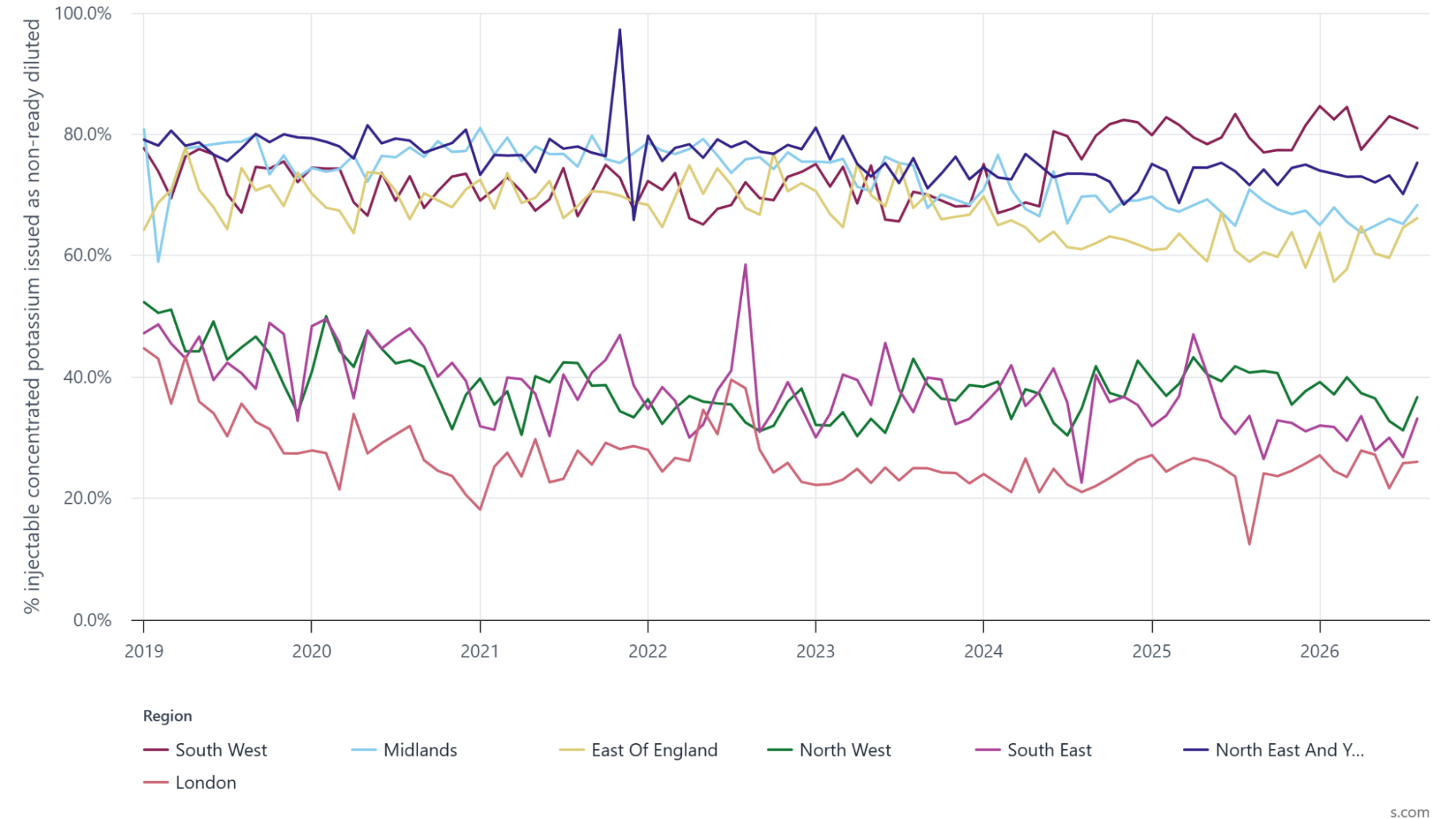
However, there is substantial variation between regions. In August 2026, the South West region issued 81% as non-ready diluted concentrated products, whilst the London region issued 26%.
Regional level variation
A measure not an indicator
Whilst lower is generally expected to be better in this measure there will be specific uses of concentrated potassium for example in production of parenteral nutrition or in neonatal units for bespoke low-volume infusions. The idea of the measure is to highlight areas of unwarranted variation, and support organisations to benchmark their use against others.
How can we use this measure to support medicines safety practice?
Bryony Dean Franklin, Professor of Medication Safety, UCL School of Pharmacy and Director, NIHR Patient Safety Research Collaboration: North West London said:
Having this data to explore variation in practice is hugely valuable - both to identify and to answer a range of research questions relating to medication safety. For example, why does this variation exist? Where might further exploration be warranted to find out whether or not higher use of non-ready-diluted preparations is appropriate? What is the impact of interventions to address any issues identified? The fact that the data are publicly available is also invaluable as it means that data can be easily accessed and explored for quality improvement, service evaluation and research.
Get in touch
As a small team of clinicians, academics, and software engineers, we are able to build and launch measures quickly by working in an agile manner, openly describing our methods and code. If you have any comments on this measure or suggestions for further developments of our measures on OpenPrescribing or OpenPrescribing Hospitals please get in touch at bennett@phc.ox.ac.uk.