


Reflections from the 2026 Public Engagement in Data Research Initiative (PEDRI) Forum
- Posted:
- Written by:
-
- Samina Begum, Godwin Daudu, Frederica Longfoot, John Kellas
- Categories:
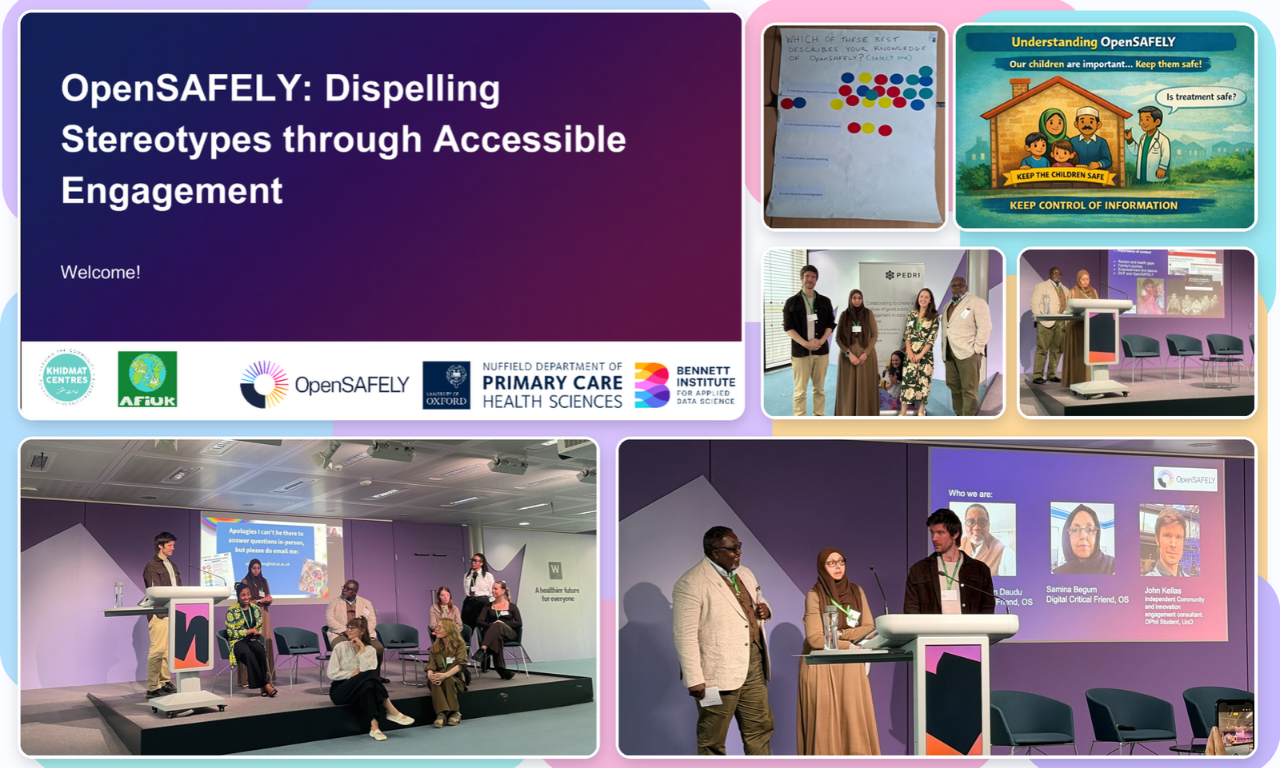
We know how important it is to involve and engage the public in the work that we do and how important public trust is to OpenSAFELY’s operation. That’s why, when we saw the call for abstracts for this year’s PEDRI (Public Engagement in Data Research Initiative) Forum, we decided to apply.
Our proposal was successful, giving Samina Begum and Godwin Daudu, two members of our Digital Critical Friends (DCFs) group, an opportunity to share their experiences of engaging underrepresented communities in health data research.
In this blog post, Samina and Godwin reflect on what they shared, what they learned from others, and what it was like to take part in the 2026 PEDRI Forum.
Sharing lessons from engaging underrepresented communities
Earlier this year, Samina and Godwin co-designed and delivered two workshops for underrepresented communities in England: one for the Pakistani community in Bradford, Yorkshire, and another for the Black British African and Caribbean community in Colchester, Essex.
At the 2026 PEDRI Forum, they presented at the Inclusion of Underserved and Underrepresented Communities in Data Research session, sharing what went well and what they learned from these workshops.
Both Samina and Godwin emphasised how important it is for researchers to understand how post-colonial history, discrimination, racism and the extraction of data and research can affect people’s trust in research. “Health inequality is real today,” says Godwin. “Over 60% of Black British people report unequal treatment from the NHS, and Black women in the UK are 4 times more likely to die in pregnancy or childbirth. These statistics are not abstractions to me. They are personal.”
For Samina, it was important to highlight the value of working with people who have connections to the communities researchers want to reach. “Our Digital Critical Friend (DCF) and community connector role was key. Godwin and I were the bridge to [those] communities,” she says.
Samina also shared that the work was a team effort, with public contributors and researchers working as equal partners. “Being able to co-present with John Kellas emphasised how we were a team working together on this,” she says. “We put lots of time into preparation, working on our presentation, and going over our scripts supported by Sophia Wilkinson and Freddie Longfoot.”
After the presentation, participants commented on how well we worked together, demonstrating both the value of teamwork, and our commitment to involving communities as equal partners, in line with PEDRI’s good practice standards.
Learning from others at the 2026 PEDRI forum
In addition to their presentation, the 2026 PEDRI Forum gave Samina and Godwin a chance to meet others and hear different perspectives on public involvement in data research.
For Godwin, attending and speaking at the forum was a highlight of his role as an ambassador for his community. He was inspired by OpenSAFELY’s commitment to public engagement and the impressive progress the team has made so far.
“Most of the presentations were about the plans to attract and involve underserved communities, whilst we were reporting on our successful engagement and lessons learned from the experience and sharing that with the conference,” he says.
But for Samina and Godwin, the work doesn’t stop here.
They’re committed to helping us build relationships with underrepresented communities, better understand why some people may not trust health data research, and involve public contributors as equal partners in this work.
Want to find out more?
We will share more reflections about the Colchester and Bradford workshops in a future blog post. For news and updates on our public and patient involvement work, keep an eye on the Public Involvement pages of our OpenSAFELY website.