


OpenPrescribing Newsletter: Autumn 2026
- Posted:
- Written by:
- Categories:

This post is part of a series: OpenPrescribing Newsletters
- OpenPrescribing Newsletter: Autumn 2026
- OpenPrescribing Newsletter: Spring 2026
- OpenPrescribing Newsletter: October 2025
- OpenPrescribing Newsletter: Autumn 2025
- OpenPrescribing Newsletter: August 2025
- OpenPrescribing Newsletter: Autumn 2024
- OpenPrescribing Newsletter: Summer 2024
- OpenPrescribing Newsletter: Spring 2024
- OpenPrescribing Newsletter: Winter 2024
- OpenPrescribing Newsletter: Autumn 2023
- OpenPrescribing Newsletter: June 2022
- OpenPrescribing Newsletter: December 2021
- OpenPrescribing Newsletter: March 2021
- OpenPrescribing Newsletter: November 2020
- OpenPrescribing Newsletter: July 2020
- OpenPrescribing Newsletter: June 2020
- OpenPrescribing Newsletter: May 2020
- OpenPrescribing Newsletter: November 2019
- OpenPrescribing Newsletter: October 2019
- OpenPrescribing Newsletter: September 2019
- OpenPrescribing Newsletter: Summer 2019
- OpenPrescribing Newsletter: June 2019
- OpenPrescribing Newsletter: May 2019
- OpenPrescribing Newsletter: February 2019
- OpenPrescribing Newsletter: December 2018
- OpenPrescribing Newsletter: October 2018
- OpenPrescribing Newsletter: July 2018
- OpenPrescribing Newsletter: June 2018
- OpenPrescribing Newsletter: May 2018
- OpenPrescribing Newsletter: April 2018
- OpenPrescribing Newsletter: March 2018
- OpenPrescribing Newsletter: February 2018
- OpenPrescribing Newsletter: January 2018
- OpenPrescribing Newsletter: December 2017
- OpenPrescribing Newsletter: November 2017
- OpenPrescribing Newsletter: October 2017
If you would like to receive news and updates on OpenPrescribing, sign up to our newsletter mailing list!
OpenPrescribing Webinars - Sign up here
We are planning a series of webinars to help users get the most out of our OpenPrescribing and OpenPrescribing Hospitals platforms. There will be a variety of themes depending on your particular area of work or interest.
Two of our November sessions coincide with key awareness weeks, Medicines Safety Week and World Antimicrobial Resistance Awareness Week.
There will be some overlap between the sessions, so there’s no need to attend them all. We suggest choosing the session that is most relevant to you.
How to use OpenPrescribing to support medicines safety
Tuesday 3rd November 2026, 1–2pm
Coinciding with #MedSafetyWeek
OpenPrescribing Refresher / Introduction
Tuesday 10th November 2026, 1–2pm
OpenPrescribing Hospitals Refresher / Introduction
Tuesday 17th November 2026, 1–2pm
How to use OpenPrescribing to support antimicrobial stewardship
Tuesday 24th November 2026, 1–2pm
Coinciding with World Antimicrobial Resistance Awareness Week 2026
OpenPrescribing advanced workshop
Tuesday 1st December 2026, 1–2pm
Featuring OpenPrescribing and OpenPrescribing Hospitals
Measures, measures, and more measures
Over the last few months, we have been busy building new measures for both OpenPrescribing (Primary Care) and for OpenPrescribing Hospitals. Measures are built based on national guidance or standards, and, for the most part, are suggested by users.
We’ve also recently established a Measures Advisory Group to gather feedback from a range of users before we launch them. Thanks to group members - it’s great to have you onboard!
Here are some of the measures we’ve been working on.
AIR/MART inhalers
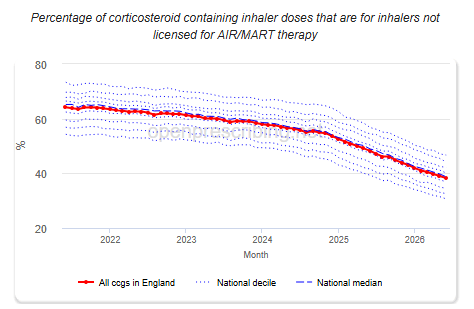
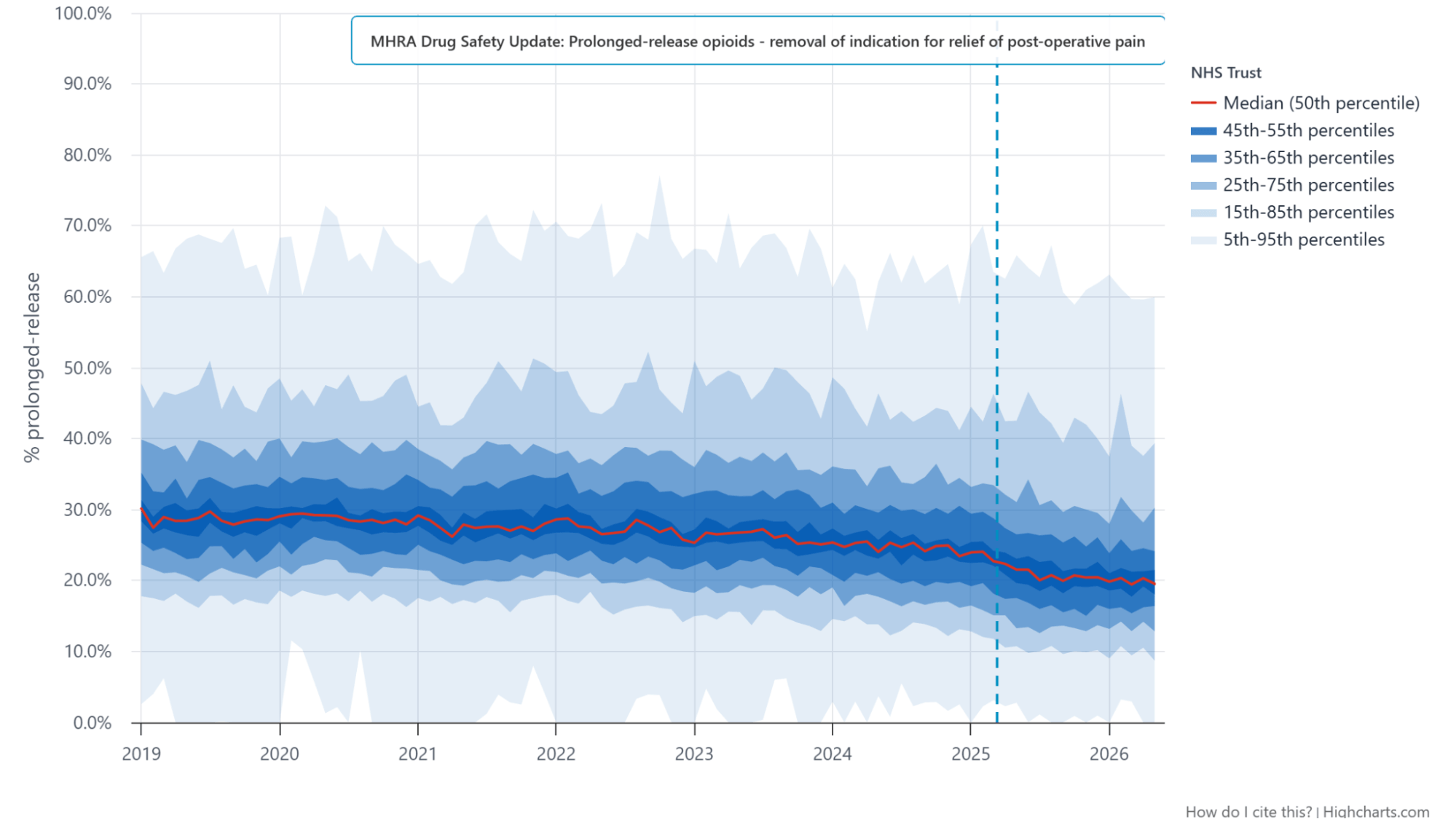
The first measure that we tested out with our Measures Advisory Group was a new AIR/MART inhaler measure looking at how prescribing of inhalers used for asthma has changed following the publication of the BTS/NICE/SIGN asthma guideline in November 2024. The measures report the percentage of corticosteroid-containing inhaler doses from inhalers not licensed for AIR/MART therapy.
Prolonged-release morphine and oxycodone
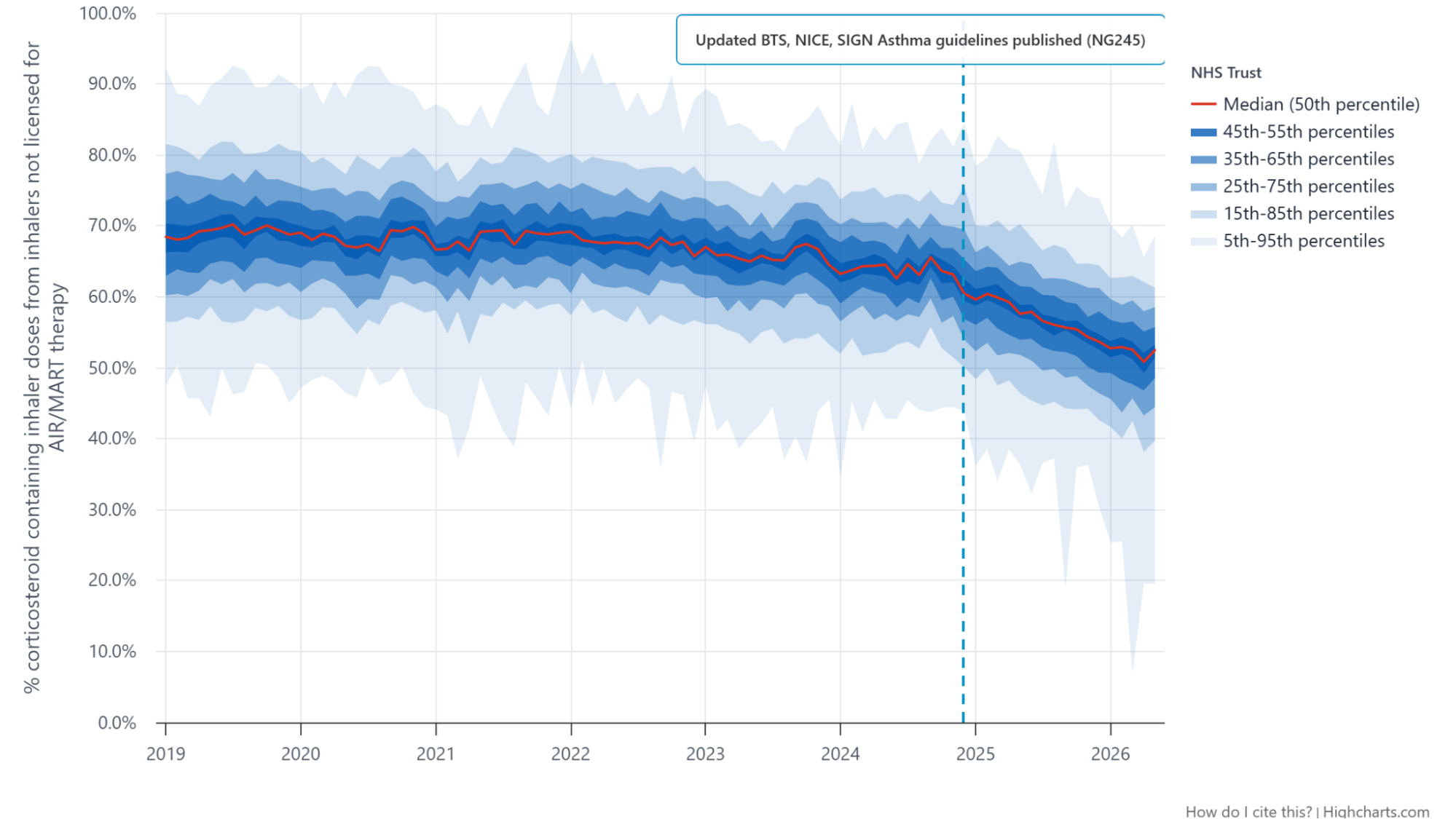
We have added our first opioid measure to OpenPrescribing Hospitals. This measure was suggested by one of our users who had been looking at the use of prolonged-release morphine and oxycodone after surgery at their trust following a recent Drug Safety Update from the MHRA. The Drug Safety Update advised healthcare professionals that prolonged-release opioids should not be used to treat acute pain after surgery.
View Prolonged-release morphine and oxycodone measure in hospitals
More on opioids
In case you missed it, we have also added two new opioid measures to OpenPrescribing in primary care, looking at oral liquid morphine prescribing, after a fantastic presentation by the brilliant Vanessa Sherwood at the Bennett Symposium last year.
The two new measures are:
- Total volume of oral morphine solution prescribed per registered patient.
View the measure - Prescribing of oral morphine solution in quantities over 300 ml.
View the measure
Low Value Measures
We have added to our low value measures in OpenPrescribing Hospitals. This was prompted by a conversation with one of our users in secondary care who had been looking at local use of low value products such as lidocaine patches using our existing measures, but also wanted to look at bath/shower emollients and rubefacients.
We took the opportunity to look again at the guidance, and consider additional items that might be useful to include. We focused on items where there is a clear case that the product is also not routinely recommended for use in hospitals for similar reasons to primary care. For example, limited evidence of clinical or cost effectiveness, or concerns about safety.
Three measures focus on items lacking evidence for clinical and cost effectiveness:
- Bath and shower emollients
- Rubefacients, benzydamine, mucopolysaccharide and cooling products
- Aliskiren
Two measures focus on items with concerns about clinical effectiveness or safety:
These measures are all available in primary care. We hope that teams will be able to look across the system for opportunities to reduce the use of low value medicines where appropriate.
Subcutaneous Pembrolizumab
We have launched our fourth OpenPrescribing measure for a new subcutaneous formulation of a common anti-cancer therapy previously only available via an intravenous infusion.
In May 2026, a new formulation of pembrolizumab, designed to be administered as a subcutaneous injection in a fraction of the time, became available for use in the UK, and received support for rollout across the NHS from NHS England. The subcutaneous preparation can be given every 3 weeks as a 1-minute injection or every 6 weeks as a 2-minute injection, depending on an individual’s cancer type.
It is early days for this measure, since the new product was only launched in May 2026, but we are excited to watch it grow.
- View uptake of pembrolizumab subcutaneous measure in hospitals
- View all the cancer therapy measures in hospitals
% Vitamin K antagonists as a proportion of all oral anticoagulants (OpenPrescribing Hospitals)
We built this measure based on feedback from anticoagulation pharmacists curious about variation in the use of warfarin rather than direct oral anticoagulants (DOAC) between hospitals.
This was prompted because the anticoagulation pharmacists said that there are still patients who are coming into hospital anticoagulated with warfarin who could be eligible to switch.
Finalised data up to March 2026 is now available in OpenPrescribing Hospitals.
We’ve previously written about the difference between provisional and finalised data in the Secondary Care Medicines Dataset (SCMD).
Monthly data within the SCMD are initially published as provisional data and are subject to change as trusts can update historical issues to reflect actual use. This is known as backtracking. After the end of the financial year, once backtracking is accounted for, data are published as finalised data.
OpenPrescribing Hospitals presents the latest available data, using the finalised data where available, and the provisional data where not.
You can also sign up to our OpenPrescribing Hospitals email alerts to be the first to hear about important new developments and also to be notified when new data is available on the site.