


New prolonged-release morphine and oxycodone measure launched in OpenPrescribing Hospitals
- Posted:
- Written by:
-
- Chris Wood, Dr Jane Quinlan, Vicky Speed, Louis Fisher
- Categories:
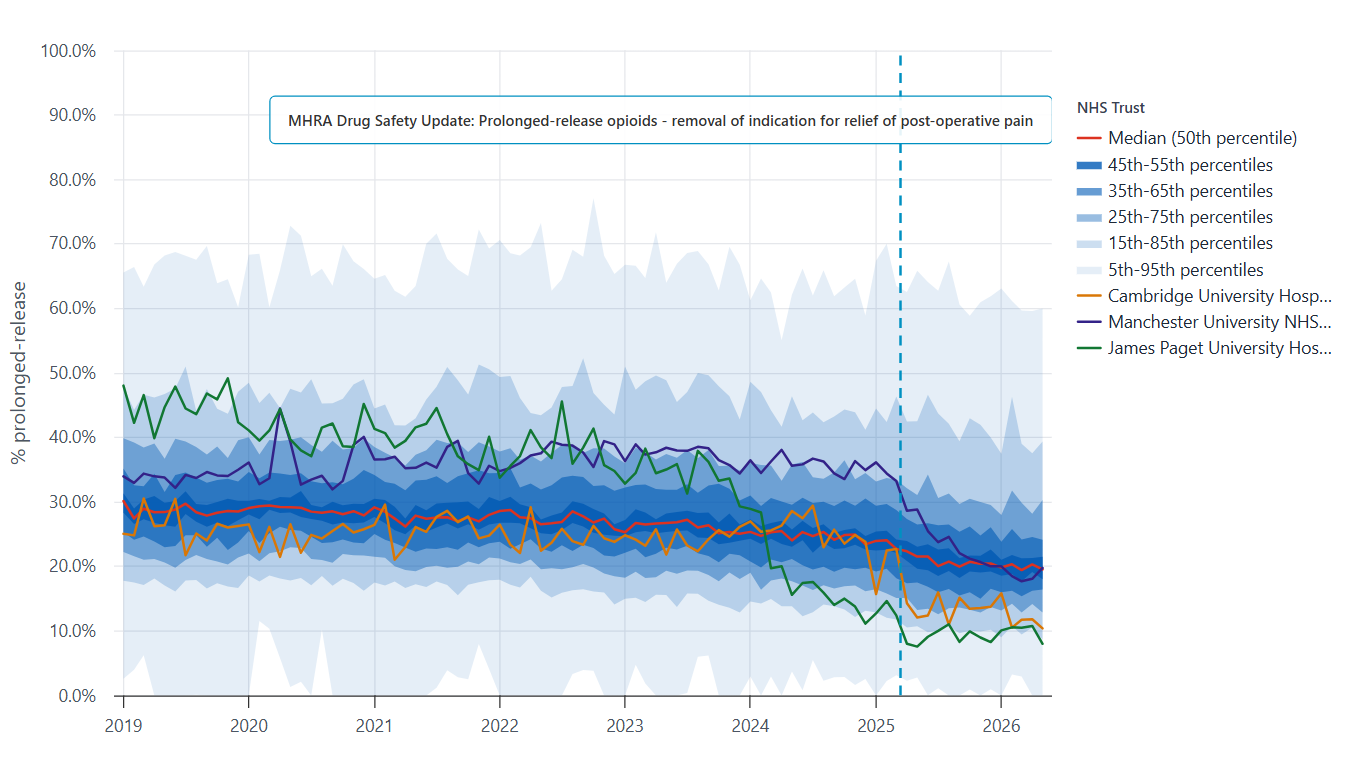
We’ve launched a new prolonged-release morphine and oxycodone measure to monitor the impact of a recent MHRA Drug Safety Update.
Why build this measure?
Several of our users suggested that we build a measure looking at the use of prolonged-release opioids after the MHRA issued a Drug Safety Update in March 2025. Following the review, and advice from the Commission on Human Medicines, the indication for the treatment of post-operative pain was removed from the licences of prolonged-release morphine and oxycodone. Our new measure focuses on oral morphine (up to 20mg) and oxycodone (up to 10mg) as these are commonly used products following surgery. The measure shows the proportion of these that are issued as prolonged-release formulations.
For most patients, post-operative pain is short lived and, where an opioid is required, is better managed using an immediate release preparation. The MHRA’s review found that use of prolonged-release opioids after surgery is associated with an increased risk of persistent opioid use beyond 90 days and opioid-induced ventilatory impairment.
This measure will help NHS teams monitor their organisation’s use of prolonged-release opioids and identify variation in prescribing practice. Where variation warrants further investigation, this can prompt a review of local prescribing practice, with resulting actions potentially helping to reduce the risk of avoidable patient harm.
Measure design
This measure was developed with support from Dr Jane Quinlan, a consultant in anaesthesia and pain management at the Oxford University Hospitals NHS Foundation Trust. Her clinical input helped shape both the design of the measure, and the choice of medicines included, helping to ensure it reflects current practice and the recommendations set out in the MHRA Drug Safety Update.
Dr Jane Quinlan, consultant in anaesthesia and pain management at the Oxford University Hospitals NHS Foundation Trust, said
“OpenPrescribing Hospitals is a great companion to the primary care focused OpenPrescribing resource, and this piece of work shows why. Prolonged-release (also known as modified- or sustained-release) opioids initiated in hospitals are more likely to lead to persistent opioid use in the community, and an increase in opioid-related complications.
Pain after trauma and surgery is not constant but it fluctuates, with pain on movement far higher than pain at rest. Prolonged-release opioid preparations, providing a constant blood level of strong opioid, are therefore neither appropriate nor safe. The levels are insufficient to cover the peaks of pain during physiotherapy and, much more dangerously, are excessive and risk sedation and opioid-induced ventilatory impairment when pain reduces back to baseline at rest.
The goal of postoperative or post-trauma recovery is to prioritise mobilisation to restore function, so immediate-release strong opioids given before physiotherapy allow those functional goals to be reached. Pain at rest is best managed with regular opioid-sparing analgesia, including paracetamol and non-steroidal anti-inflammatories.
While the MHRA drug safety update relates to postoperative pain, the same principles apply to any patient admitted to hospital with acute pain, so the initiation of prolonged-release opioids in hospital is rarely appropriate. While these figures from OpenPrescribing Hospitals may include patients already established on prolonged-release opioids due to chronic pain (also inappropriate, but see OpenPrescribing for more information), it is encouraging that hospital prescribing has dipped since the MHRA alert. I would hope to see continued reduction, with associated improvements in patient safety.”
Explore your data
You can also use our analyse page to investigate the use of medicines across NHS Trusts, ICBs, regions and nationally.
For example, to explore trends in opioid prescribing, you can:
- Compare changing trends in codeine vs dihydrocodeine use
- Look at trends in fentanyl patch use across regions
- Review the volume of morphine sulfate 10mg/5ml oral solution used within your trust
These types of analyses can help you quickly explore variation in opioid use between organisations or examine trends over time.
Get in touch
As a small team of clinicians, academics, and software engineers, we build and launch measures quickly by working in an agile manner, openly describing our methods and code. If you have any comments on this measure, or suggestions for further developments of our measures on OpenPrescribing or OpenPrescribing Hospitals, please get in touch at bennett@phc.ox.ac.uk.