


New anticoagulation measure launched in OpenPrescribing Hospitals
- Posted:
- Written by:
-
- Vicky Speed, Chris Wood, Rosalind Byrne, Louis Fisher
- Categories:
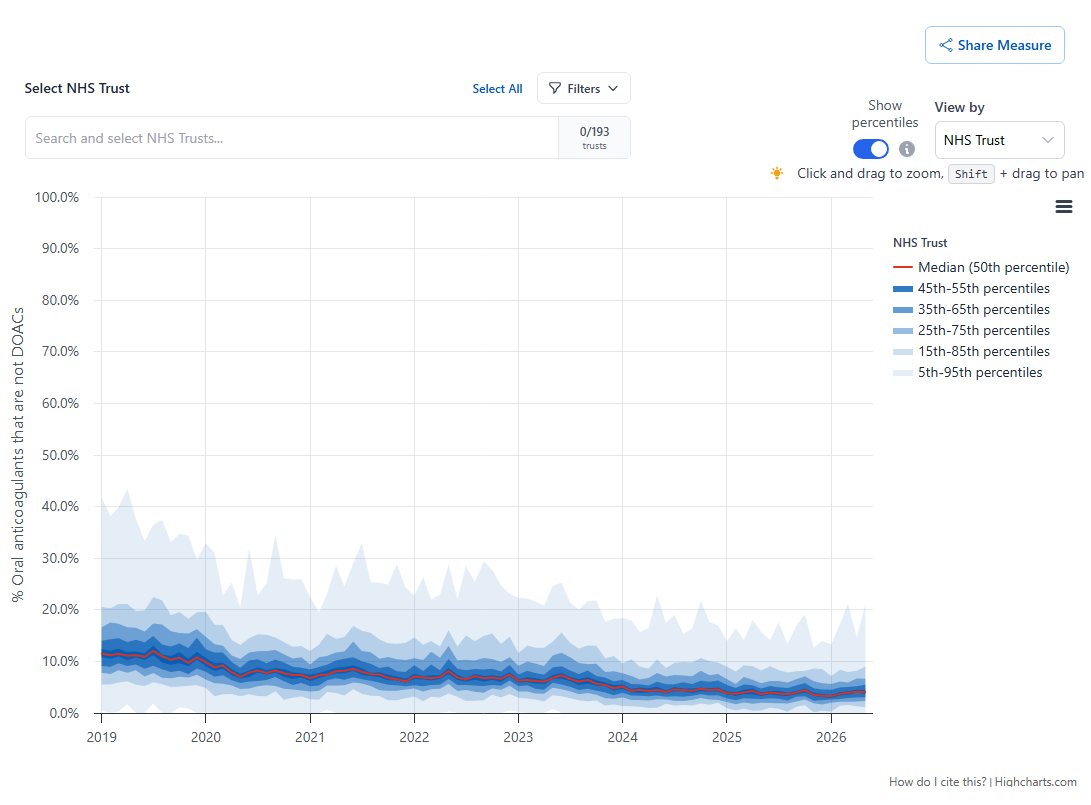
We’ve launched a new measure to monitor the percentage of oral anticoagulants that are issued as vitamin K antagonists (VKA) (most commonly warfarin).
Why build this measure?
We built this measure based on feedback from anticoagulation pharmacists curious about variation in the number of anticoagulated patients who were on warfarin rather than a direct oral anticoagulant (DOAC). The anticoagulation pharmacists were asking, as there are still patients who come into hospital anticoagulated with warfarin who could be eligible to switch.
Consultant Pharmacist Rosalind Byrne at the King’s College Hospital NHS Foundation Trust said:
This OpenPrescribing measure gives us a valuable way to see how our prescribing compares with other organisations. We did a lot of work during the pandemic to switch eligible patients from warfarin to DOACs, but we still see patients presenting to hospital on warfarin who may be suitable for a DOAC. Without this data, it is difficult to know how we are doing from a secondary care perspective in comparison to other organisations.
Why DOACs over Vitamin K Antagonists?
DOACs offer several advantages over warfarin. They have a more predictable anticoagulant effect, can be given at a fixed dose without frequent routine monitoring, and have fewer drug and food interactions. This makes them a more convenient option for many patients. They are considered to be generally safer and at least as effective as warfarin for both AF and VTE.
And, even better, there’s no need to avoid the brussel sprouts at Christmas!
What do NICE guidelines say?
For atrial fibrillation (AF), NICE guideline NG196 recommends a DOAC for people who require anticoagulation for stroke prevention.
If DOACs are contraindicated, not tolerated or unsuitable, a VKA, such as warfarin, should be offered. People already taking a VKA with stable anticoagulation may continue treatment, with the risks and benefits of switching to a DOAC discussed at their next routine appointment, taking into account their time in therapeutic range.
For venous thromboembolism (VTE), NICE guideline NG158 recommends apixaban or rivaroxaban for most people with confirmed proximal deep vein thrombosis (DVT) or pulmonary embolism (PE), with alternative anticoagulation options for people in whom these treatments are unsuitable or who have particular clinical circumstances.
AF and VTE are the two most common indications for oral anticoagulant use, and DOACs are suitable for most people requiring anticoagulation for these indications. Lower values are therefore generally better for this measure. However, VKAs remain appropriate for some patients, including those with mechanical heart valves or established triple-positive antiphospholipid syndrome.
More on anticoagulation on OpenPrescribing
The new measure joins other useful tools on OpenPrescribing to explore anticoagulant usage in both primary and secondary care.
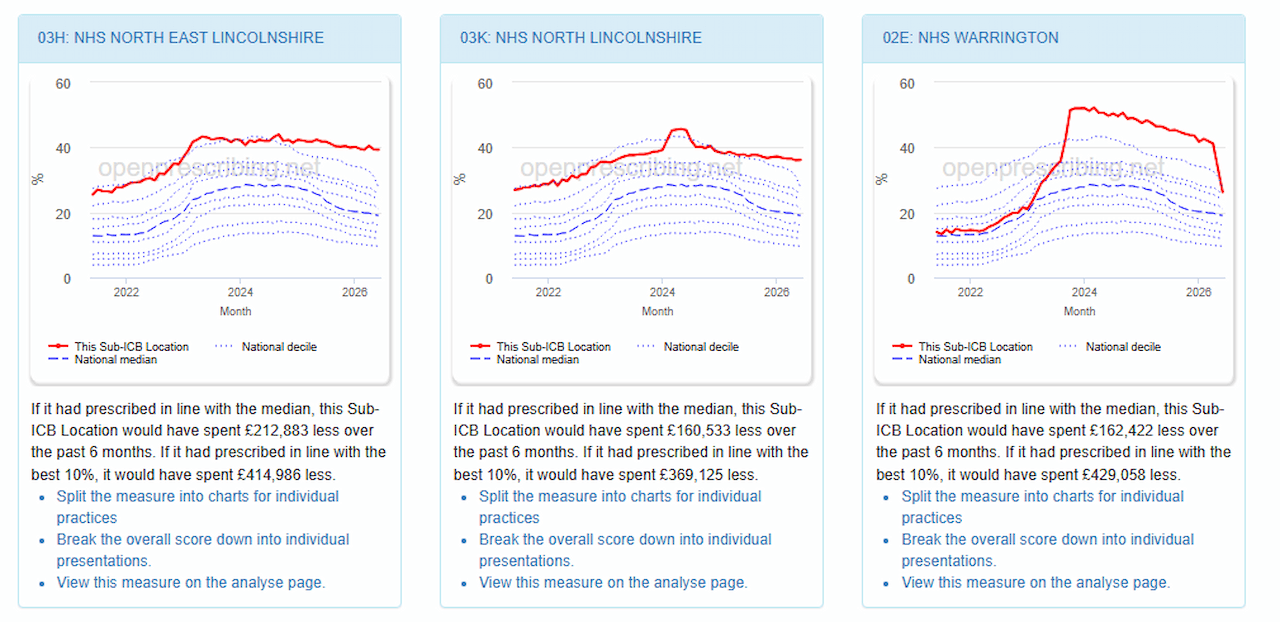
Best value DOAC measures in Primary Care and Secondary Care
In September 2024 the NHS in England released updated commissioning recommendations for DOACs, which state:
For patients commencing treatment for atrial fibrillation (AF): subject to the criteria specified in the relevant NICE technology appraisal guidance, clinicians should use the best value DOAC that is clinically appropriate for the patient. Apixaban and rivaroxaban (prescribed generically) are currently the joint best value DOACs.
Check out the use of best value DOACs at your organisation here:
For anticoagulation specialists we have also added a new antithrombotic stewardship tag so you can find all anticoagulation related measures in one place!
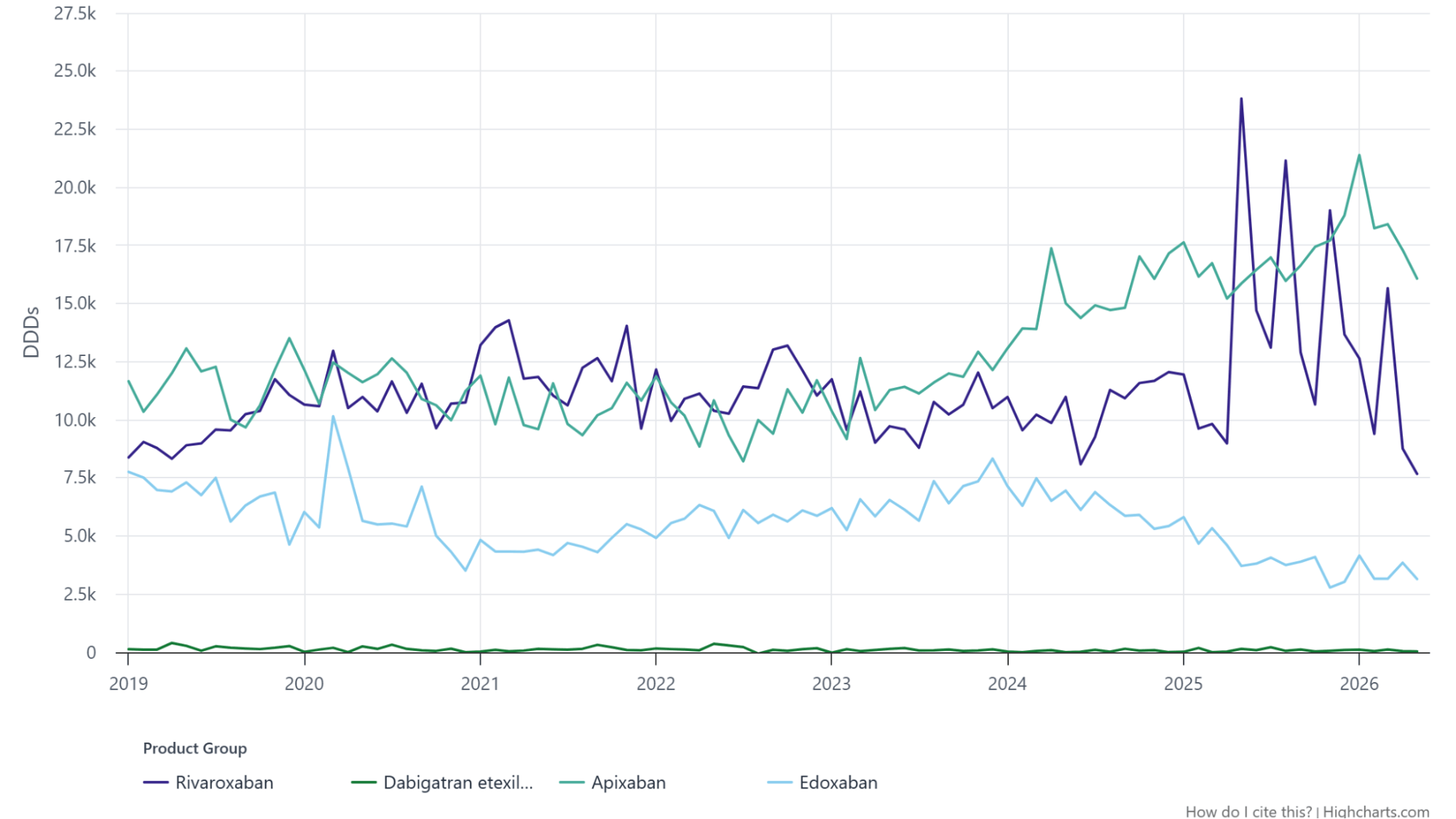
Build you own analysis for audit and feedback at your trust
Use the analyse page to build your own analysis. Audit your own DOAC use and save the url so you have a ready made data collection tool for auditing you use.
Get in touch
As a small team of clinicians, academics, and software engineers, we build and launch measures quickly by working in an agile manner, openly describing our methods and code. If you have any comments on this measure, or suggestions for further developments of our measures on OpenPrescribing or OpenPrescribing Hospitals, please get in touch at bennett@phc.ox.ac.uk.